



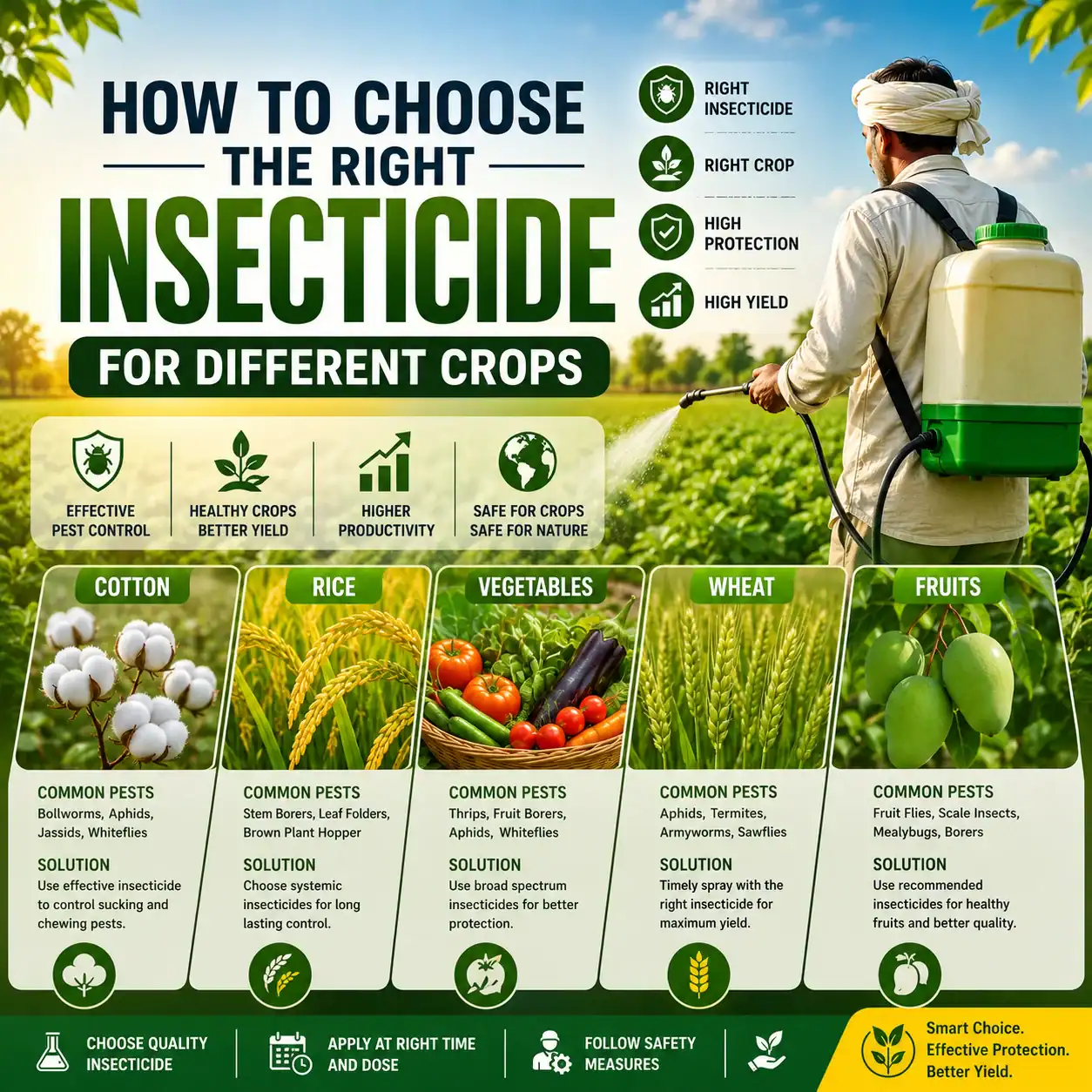
In the heart of India’s agricultural landscape, every farmer knows that a healthy crop is the result of tireless labour, perfect timing, and, most importantly, effective protection. Whether you are growing paddy in the lush fields of Punjab or cotton in the black soil of Maharashtra, pests are an inevitable challenge.
Using an insecticide is often the difference between a bumper harvest and a devastating loss. However, with hundreds of products available in the market, the real challenge isn’t just finding an insecticide—it is choosing the right one for your specific crop and pest problem.
In this comprehensive guide, we will walk you through everything you need to know about selecting the best agricultural insecticide, understanding different formulations, and applying them safely to ensure your farm thrives.
The Importance of Choosing the Right Insecticide
Not all insects are the same, and neither are all insecticides. Choosing the wrong product can lead to several problems:
- Wasted Investment: Insecticides are a significant part of a farmer’s budget. Using the wrong one results in financial loss without solving the pest issue.
- Pest Resistance: Misuse of chemicals can lead to “super-pests” that no longer respond to treatments.
- Crop Damage: Some chemicals, if applied to the wrong crop at the wrong stage, can cause phytotoxicity (burning of leaves).
- Environmental Impact: The right choice ensures minimal harm to beneficial insects like honeybees and soil health.
Effective crop protection starts with knowledge. By matching the product to the pest’s biology and the crop’s growth stage, you maximize efficiency and minimize risk.
Understanding the Types of Insecticides
Before you head to the distributor, you must understand how different products work. Most insecticides for crops fall into three main categories based on their mode of entry:
1. Systemic Insecticide
A systemic insecticide is absorbed by the plant’s tissues (roots, stems, or leaves). When an insect feeds on any part of the plant, it ingests the chemical and dies.
- Best for: Sucking pests like aphids, jassids, whiteflies, and thrips.
- Advantage: Provides long-lasting protection and protects new growth that emerges after application.
2. Contact Insecticide
These work only if the chemical physically touches the insect. They are usually sprayed directly on the pest or the surfaces where the pest crawls.
- Best for: Chewing pests like caterpillars, beetles, and larvae.
- Advantage: Offers quick “knock-down” effects, killing pests immediately upon contact.
3. Biological & Botanical Insecticides
Derived from natural sources like fungi, bacteria, or plant extracts (e.g., Neem oil, Bacillus thuringiensis).
- Best for: Integrated Pest Management (IPM) and organic farming.
- Advantage: Extremely safe for humans, the environment, and beneficial predators.
Crop-wise Insecticide Selection: India-Specific Insights
Different crops attract different “enemy” insects. Here is a breakdown of how to choose the right insecticide for India’s most common crops.
1. Cotton (The Silver Fiber)
Cotton is highly susceptible to the “Sucking Pest Complex” and Bollworms.
- Key Pests: Whitefly, Aphids, American Bollworm, Pink Bollworm.
- Selection Advice: For early-stage sucking pests, a systemic insecticide is preferred. For Bollworms, a combination of contact and stomach poisons is often necessary during the flowering stage.
2. Rice / Paddy
Rice is the staple of India, but it faces heavy pressure from stem-dwellers.
- Key Pests: Yellow Stem Borer, Brown Plant Hopper (BPH), Leaf Folder.
- Selection Advice: Use granular insecticides for stem borers during the vegetative stage. For BPH, targeted sprays that reach the base of the plant are essential.
3. Wheat
Wheat is generally hardier but faces issues during dry spells.
- Key Pests: Aphids, Termites, Pink Borer.
- Selection Advice: Seed treatment is the best pest control method for termites. For aphids, timely foliar sprays are effective.
4. Vegetables (Tomato, Chilli, Brinjal)
Vegetables require frequent harvesting, so the “Safety Period” (PHI) is critical.
- Key Pests: Fruit and Shoot Borer, Thrips, Mites.
- Selection Advice: Choose products with a short waiting period so the produce remains safe for consumers.
5. Fruit Crops (Mango, Citrus, Pomegranate)
- Key Pests: Fruit Fly, Mealybugs, Hoppers.
- Selection Advice: Oil-based emulsions work well for mealybugs, while bait-based insecticides are better for fruit flies.
| Crop | Common Pest | Recommended Insecticide Type |
| Cotton | Whitefly / Jassid | Systemic (Neonicotinoids) |
| Rice | Stem Borer | Granular / Systemic |
| Vegetables | Caterpillars | Contact / Biological |
| Fruits | Mealybugs | Contact + Surfactant |
| Wheat | Termites | Seed Treatment / Soil Application |
Factors to Consider Before Choosing an Insecticide
When standing at an agri-retail shop, ask yourself these five questions:
- What is the Pest’s Feeding Habit? Is it chewing the leaves or sucking the sap? Sucking pests need systemic action; chewing pests need contact action.
- What is the Crop Stage? Avoid harsh chemicals during the peak flowering stage to protect pollinators like bees.
- Weather Conditions: Do not spray if rain is expected within 2-4 hours. High winds can cause “spray drift,” wasting your agricultural insecticide.
- Label Color Code:
- Red: Extremely Toxic (Use with extreme caution).
- Yellow: Highly Toxic.
- Blue: Moderately Toxic.
- Green: Slightly Toxic (Preferable for most applications).
- Pre-Harvest Interval (PHI): This is the number of days you must wait between the last spray and harvesting the crop. Always check the label!
Expert Safe Usage Guidelines for Farmers
Safety is non-negotiable. Using an insecticide incorrectly can harm your health and your soil.
- Read the Label: Every bottle comes with a leaflet. Read the dosage carefully. More is NOT better; it only increases costs and toxicity.
- Wear PPE: Always wear gloves, a face mask, and full-sleeved clothing. Never spray against the wind.
- Calibration: Ensure your sprayer is working correctly and the nozzle provides a uniform mist.
- Triple Rinse: Once a container is empty, rinse it three times with water, pour the rinse into the spray tank, and puncture the bottle so it cannot be reused.
Pro Tip: Always mix the insecticide in a separate bucket before pouring it into the sprayer tank. This ensures a uniform solution.
Common Mistakes Farmers Should Avoid
- The “Cocktail” Mistake: Mixing 4-5 different chemicals together. This can cause a chemical reaction that reduces effectiveness or kills the plant.
- Using the Same Product Repeatedly: Pests develop resistance. If you used a specific insecticide last month, switch to a different chemical group this month.
- Inaccurate Dosage: Using a “cup” or “lid” to measure instead of a proper measuring cylinder leads to under-dosing (pest survives) or over-dosing (crop burns).
- Spray Timing: Spraying during the hot afternoon. The best time is early morning or late evening when the sun is not too bright.
Resistance Management: The Key to Long-term Success
Insecticide resistance is a growing threat in India. When a pest survives a spray, its offspring are often immune to that chemical. To prevent this:
- Rotate Chemistries: Use the “Window Strategy.” Use one type of insecticide for one generation of pests, then switch to a completely different mode of action for the next.
- Integrate Methods: Use yellow sticky traps, pheromone traps, and light traps alongside chemical methods.
- Protect Natural Enemies: Encourage ladybugs and spiders in your field; they are your free pest control army.
Sustainable Farming and Modern Crop Protection
Modern agriculture is moving toward “Integrated Pest Management” (IPM). This doesn’t mean stopping the use of insecticides, but using them wisely.
By choosing high-quality, targeted products like those offered by Synergy Agri Products, farmers can achieve higher yields with fewer sprays. Sustainability is about ensuring the soil remains fertile for the next generation while keeping the current harvest profitable.
Why Choose Synergy Agri Products?
At Synergy Agri Products, we understand the unique challenges of the Indian farmer. Our range of crop protection solutions is designed with precision, ensuring:
- High Efficacy: Our formulations are tested across diverse Indian climates.
- Cost-Effectiveness: We focus on products that offer long-lasting protection, reducing the number of sprays needed.
- Technical Support: We don’t just sell products; we provide the knowledge on how to use them for maximum ROI.
- Safety First: Our products are manufactured keeping international safety and quality standards in mind.
Whether you are a distributor looking for reliable supply or a farmer aiming for a record yield, Synergy Agri Products is your trusted partner in growth.
Conclusion
Choosing the right insecticide is both a science and an art. It requires observing your fields closely, understanding the pests, and selecting a product that is effective yet safe. By following the guidelines in this guide—rotating your chemicals, respecting safety labels, and choosing quality brands—you can protect your hard work and ensure a prosperous harvest.
Remember, the goal of pest control is not just to kill insects, but to protect the life and health of your crop.
Ready to boost your yield?
[Explore Synergy Agri Products’ Full Range of Insecticides Here] (Internal Link Placeholder)
FAQs
Q1: What is the difference between contact and systemic insecticide?
A: A contact insecticide kills pests on direct touch, whereas a systemic insecticide is absorbed by the plant and kills pests when they feed on the plant’s sap or leaves.
Q2: Can I mix two different insecticides together?
A: While some combinations are compatible, you should always check the compatibility chart or consult an expert. Mixing incompatible chemicals can cause the spray to fail or damage the crop.
Q3: How often should I spray insecticide on my crops?
A: This depends on the “Economic Threshold Level” (ETL). Only spray when the pest population reaches a level that could cause significant financial loss. Generally, follow the schedule recommended on the product label.
Q4: Is a more expensive insecticide always better?
A: Not necessarily. The “best” insecticide is the one that targets your specific pest at the right time. However, high-quality brands like Synergy Agri Products ensure purity and better results compared to unbranded, cheap alternatives.
Q5: What should I do if it rains immediately after spraying?
A: If it rains within 1-2 hours of application, the chemical may be washed off. You may need to re-apply, but check if the product has “rain-fastness” properties first.
Internal Linking Suggestions
- Link to “How to Identify Sucking Pests in Cotton” (Blog post).
- Link to “The Role of Bio-Stimulants in Crop Growth” (Blog post).
- Link to the Product Category Page: “Insecticides for Rice and Wheat.”
Image Suggestions
- Header Image: A high-quality photo of a healthy Indian field (Paddy or Cotton) with a farmer inspecting leaves.
- Section 1 (Types): A diagram showing how systemic insecticides travel through a plant vs. contact spray on the surface.
- Section 2 (Crops): A collage showing rice, wheat, and vegetables with their common pests.
- Safety Section: An infographic showing the 4 color-coded toxicity labels (Red, Yellow, Blue, Green).
- CTA Section: A professional photo of a Synergy Agri Product bottle with a “Contact Us” button.
Are you struggling with persistent pests in your field? Don’t let your hard work go to waste. Contact Synergy Agri Products today for expert advice and the most effective insecticide solutions tailored for Indian agriculture. Visit our website or call our helpline now!

